
This cork flooring comparison puts eight flooring categories side-by-side across seven performance dimensions: comfort, warmth, quiet, resilience, allergen resistance, healthy air, and renewability. Every category gets credit where it earns it. Cork is the only one strong in all seven.
Cork Flooring vs. Other Flooring: Seven Performance Dimensions
| Perfromance Dimension | Cork | LVP / LVT | Hardwood | Laminate | Tile / Stone | Carpet | Rubber | Linoleum |
| Comfort underfoot | Strong | Partial | Weak | Weak | Weak | Strong | Strong | Partial |
| Warmth & insulation | Strong | Partial | Partial | Partial | Weak | Strong | Partial | Partial |
| Quiet (impact & airborne) | Strong | Partial | Weak | Weak | Weak | Strong | Strong | Partial |
| Resilience & recovery | Strong | Partial | Weak | Weak | Weak | Weak | Strong | Partial |
| Resists mold & allergens | Strong | Partial | Partial | Partial | Partial | Weak | Partial | Strong |
| PVC-free & healthy air | Strong | Weak | Strong | Strong | Strong | Partial | Partial | Strong |
| Rapidly renewable material | Strong | Weak | Partial | Partial | Partial | Weak | Weak | Strong |
| Category Strengths | 7 | 0 | 1 | 0 | 1 | 3 | 3 | 3 |
| Strong = category strength · Partial = varies / partial · Weak = typical weakness. This is a directional comparison of typical category construction; specific products vary. |
Reading the Table
Cork is the only column with a full mark in every row. Cork flooring offers the comfort, warmth, and quiet people choose carpet for; the healthiness, PVC-free build, and renewability of Linoleum; and the resilience and quieting desired in rubber. However, every other category trades one strength away to get another. Cork isn't a compromise between categories. It's the overlap of their best qualities.
Cork is strong in providing:
- Comfort underfoot: the give that makes standing easy
- Warmth & insulation: feels warm over slab or basement
- Quiet (impact & airborne): absorbs sound instead of transmitting it
- Resilience & recovery: springs back, doesn't chip or crack
- Resists mold & allergens: suberin naturally resists mold, mildew & dust mites
- PVC-free & healthy air: no vinyl, no harmful off-gassing
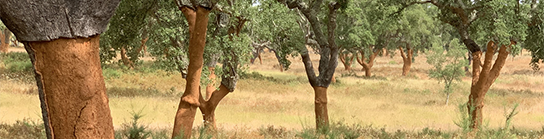
- Rapidly renewable material: harvested without cutting the tree, absorbs more CO2 while bark regrows
Cork Flooring by the Numbers
- 200M air cells / in³: absorb impact and airborne sound
- 14,000 PSI: withstood without breaking, with 97–100% recovery from typical loads
- 50% air by volume: dead-air insulation, warm over slab
- 17–19 dB: impact sound cut, every floating floor
- AC5 / Class 33: commercial rating for Serenity (see more below)
- 9-year bark cycle: hand harvested; the tree is never cut
Cork Durability - Commercial Grade
Today's advanced cork flooring is a highly reliable and durable flooring solution. While some of our cork flooring is rated for light commercial, WECORK offers numerous commercial grade cork floors including:
- Serenity Collection (floating planks) - Patented Hot Coating finish is fade, water, and scratch resistant. Fully commercial grade, AC5 / Class 33 rated with a 25-year residential wear warranty.
- Classic Collection (glue-down tiles) - Finished with three coats of Greenshield, which is 4× stronger than most UV acrylics. Backed by a lifetime residential structural warranty.
- Avant Garde (glue-down tiles) - Same Greenshield finish or HRF (High Resistance Finish) commercial finish - see our cork flooring brochure for specifics.
* Optional coats of a water-based polyurethane finish are recommended for commercial projects, kitchens, and bathrooms to seal the surface and seams of Greenshield finished floors.
Cork Flooring Questions, Answered
"How does cork handle water and liquids?"
Cork is the material the world trusts to seal wine. Naturally occurring suberin makes it moisture shedding, and spills wipe from the finished surface. (Best practice is to wipe standing liquids promptly.) For kitchens and full baths, choose Corkoleum (ranked #3 in This Old House's Top 20 New Home Products) or bath-rated glue-down tile - Classic or Avant Garde.
"Will it dry out or shrink?"
Cork isn't lumber. It's billions of suberin-sealed air cells, the structure that keeps a wine cork elastic for decades. The finish seals the surface; an annual Bona refresh keeps it that way.
"What about heat and humidity swings?"
Movement is engineered in, not fought: floors acclimate, float, and breathe within a hidden perimeter expansion space. Approved for use over radiant heat. The layer bond itself carries a lifetime residential structural warranty. See also How Does Humidity Affect Cork Flooring?
"Won't it dent?"
Cork compresses and springs back. A dent typically recovers with a damp, warm cloth. Use felt pads under furniture, same as any fine floor.
"Does it fade?"
A gentle patina is an inherent, expected characteristic of natural cork. Serenity's printed visuals are fade resistant for sun-heavy rooms. See also Fade Resistant Cork Flooring – How Is It Made?
"Is it healthy?"
PVC-free, and every floating collection is GreenGuard Gold certified or Eco Platform EPD verified. Natural suberin resists mold, mildew, and dust mites, with no harmful VOC off-gassing.
One Material, Every Look
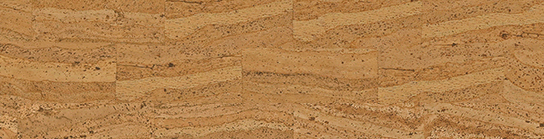
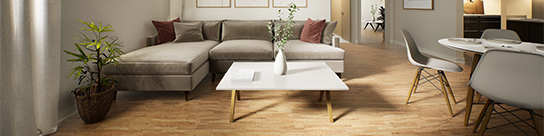
WECORK offers dozens of flooring patterns and colors across five cork flooring collections, in floating and/or glue down format. Below is a just a sampling of some of our popular options.


The WECORK Difference
Cork floors perform strongly in categories that matter. The premium cork used in WECORK flooring is sourced mostly from Portugal, and entirely from the Mediterranean region. Celebrating over 50 years in business, WECORK is family-owned and operated, representing the sixth-generation in cork. We love introducing customers to cork and explaining all of cork's natural benefits, so contact us today for more information.
Did you find this article helpful?
If you found this article informative and would like a downloadable version to share with a friend or colleague, click the button below.